

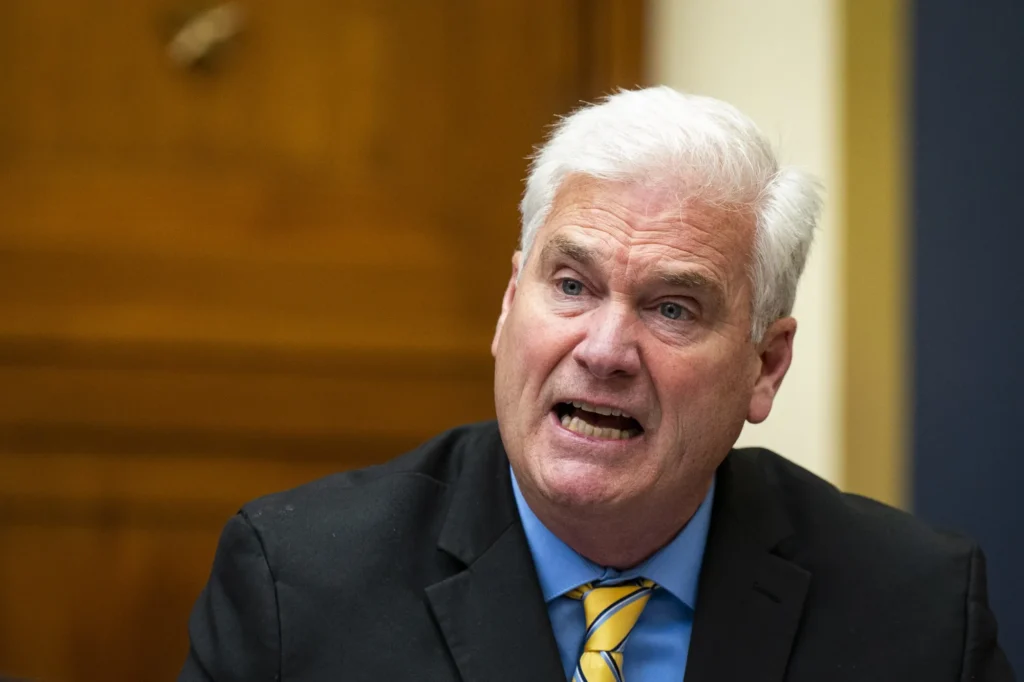
Tom Emmer Photographer: Al Drago/Bloomberg
The recent rhetoric coming from Tom Emmer has done more than spark outrage. It has awakened Somali Minnesotans across the state. By repeatedly singling out Somalis in conversations about fraud, denaturalization, and deportation, Emmer is not addressing crime. He is redefining who belongs in America and who does not.
This moment is bigger than one politician. It raises a fundamental question about whether citizenship in this country remains a constitutional right or becomes a conditional status that can be threatened for political gain.
What is becoming increasingly clear is that Minnesota politics is entering a new moment. Many Somali Americans who sat out previous elections, and even some who voted for Donald Trump in the past, are now expressing a level of unity rarely seen before. Anger over being collectively targeted, misrepresented, and used as a political wedge has cut across age, ideology, and background. Community organizers and elders alike note that this moment feels different. Somali Americans are more aligned, more engaged, and more motivated than at any point in recent memory. That shift has the potential to reshape turnout and electoral outcomes statewide, and it is already being felt in political conversations across Minnesota.
Community leaders are also raising alarms about the real-world danger of this rhetoric. Doug Chapin, a democrat who is running against Tom Emmer for Congress, warned that anti-immigrant sentiment is an ugly constant in America’s history and that Somali American neighbors are experiencing the worst of it right now.
He has emerged as a consistent public voice calling out Tom Emmer’s rhetoric and standing in solidarity with Somali Minnesotans. Chapin has repeatedly criticized the use of broad, accusatory language that places entire communities under suspicion, arguing that leadership requires accuracy, restraint, and respect for constitutional principles. He warned that anti-immigrant sentiment is an ugly constant in America’s history, and that Somali American neighbors are experiencing the worst of it right now. He noted that what makes this moment especially disturbing is that these attacks are not truly about Somali Americans, but about partisan efforts to attack the governor and broader hostility toward using public funds to support people in need.
Chapin cautioned that Congressman Tom Emmer, the president, and other Republican leaders are choosing to hide antigovernment sentiment behind ugly racist rhetoric that places neighbors in genuine danger. He pointed to increasing traffic on social media calling for punishment of Somali Americans, including posts that advocate physical violence, calling it completely unacceptable and un-American. Chapin urged Emmer and other leaders to walk back the hateful language before someone gets hurt.
Community voices have also responded with clarity and principle. Hodan Hassan, a former Minnesota state representative, spoke directly to the constitutional danger of this rhetoric. She reminded the public that the Fourteenth Amendment makes citizenship a right, not a privilege subject to political whim. She warned that expanding denaturalization beyond proven fraud violates due process and equal protection, and that once citizenship becomes conditional, everyone’s rights are at risk. Her words grounded the conversation where it belongs, in the Constitution and the rule of law.
Another powerful voice came from Abdi H. Daisane, who emphasized that this country was built on a simple idea: equal protection under the law. He cautioned that when governments begin threatening to strip citizenship, it is not about safety, but about redefining who belongs and who deserves protection. Dehumanizing immigrants, discussing denaturalization, and deporting people without due process, he warned, is not accidental. It is planned. And it is dangerous.
Let us be clear. Fraud exists. Fraud is a crime. Anyone who commits fraud, regardless of race, religion, or immigration status, should be investigated and prosecuted under the law. Accountability matters. But a crime committed by a few does not define an entire community. Somali Minnesotans are not a headline or a talking point. They are business owners, healthcare workers, educators, students, parents, and taxpayers who contribute every day to Minnesota’s economy and civic life.
What makes Emmer’s rhetoric especially harmful is that it does not stop at individual accountability. It paints an entire community as suspect and disposable. That kind of language fuels misinformation, invites harassment, and places real people at risk. History shows that when leaders normalize collective blame, the consequences rarely remain rhetorical.
That danger has already played out locally. A Republican-aligned journalist and social media personality, Nick Shirley, played a central role in spreading a viral claim against Quality Learning Center, a Somali-owned daycare in Minnesota.
In widely circulated online content, Shirley recorded footage before the daycare’s normal opening hours and used it to claim the center was not operating. That framing was amplified online, creating the impression of wrongdoing where none had been established. What those posts failed to disclose was that the video was recorded outside business hours, a critical omission that undermined the claim.
Following the false accusations, the daycare owner’s son publicly addressed the media and the community, explaining the circumstances and rejecting the narrative as misleading. His response demonstrated how easily misinformation can be manufactured, edited, and weaponized once it enters partisan media ecosystems.
These narratives have had real policy consequences that extend far beyond the Somali community. In a recent announcement, the U.S. Department of Health and Human Services confirmed that it has frozen childcare payments to the state of Minnesota while expanding fraud investigations. This action affects daycare providers across the entire state, including many non-Somali providers who rely on timely reimbursements to keep their doors open.
Licensed childcare centers, family-run daycares, and providers serving working families of all backgrounds are now facing uncertainty because of a broad response to allegations driven, in part, by viral videos and politicized narratives. The freeze does not distinguish between communities. It impacts educators, parents, and children statewide, underscoring how sweeping rhetoric and sensational claims can trigger consequences that harm innocent people.
What ties these episodes together is not coincidence but strategy. Individual stories are stripped of context, amplified by partisan actors, and then used to justify sweeping claims about entire communities. This is how misinformation becomes a political weapon, and why silence from elected leaders only deepens the damage.
What is increasingly clear is that the Somali community is awake and paying close attention. Somali Minnesotans are politically engaged, informed, and organized. Conversations are happening in community centers, coffee shops, and living rooms across Minnesota. Community members are taking notes, remembering names, and evaluating who truly represents their values and who is willing to defend constitutional principles when it matters.
This is not about threats or hostility. It is about democratic accountability. Elections are where rhetoric meets consequence. November will be a test of whether divisive politics can outweigh the lived reality of Minnesota’s diverse communities.
America is strongest when the Constitution protects everyone equally. Somali Minnesotans are not asking for special treatment. They are asking for the same rights promised to every citizen and the same protection under the law. When those rights are questioned for one group, they are weakened for all.
The message coming from the community is unmistakable. Somali Minnesotans will not be defined by the actions of a few. They will not accept collective blame. And they will use the democratic process to defend their dignity, their safety, and their rightful place in this country.
About Author


More Stories
Islamic Center 2026 19th Annual
Islamic Center of St. Cloud is hosting its 19th Annual Convention on Saturday, October 3, 2026.
Residents raise concerns over Flock cameras at City Hall tonight. What do you think about the ALPR?